
I participated in NYK Minabe's loggerhead turtle research program! (July 14-16, 2022)
As a member of the NYK Group, I participated in a volunteer program conducted jointly by Nippon Yusen Kabushiki Kaisha (NYK) and the certified nonprofit organization Earthwatch Japan (EWJ). This program, which began in 2016 and is now in its seventh year, was held for the first time in three years due to the COVID-19 pandemic. I participated from July 14th to 16th (two nights and three days). Specifically, the program taught me about marine environmental conservation through an ecological survey of loggerhead turtles, an endangered species that comes ashore to lay eggs on the beaches of Minabe Town, Hidaka District, Wakayama Prefecture. My motivation for participating was half the desire to be a part of the project, and the other half was pure interest in sea turtles and ecological surveys. Kinkai Yusen Co., Ltd. has decided to donate and continue to support a research vessel to the Kuroshima Research Institute, an affiliated research institute of the Sea Turtle Association of Japan, to study sea turtles.
I'll say this early because it may disappoint you, but during this activity we were unable to observe any sea turtles laying eggs!!
I'm sure you're hearing people asking, "Didn't you go during the nesting season? What was the point of going?" But my current impression is that it's extremely presumptuous to try to experience in just three days what researchers have been studying for decades while dealing with nature. It's unfortunate that we didn't see any sea turtles because (by chance) we were in the gap between the nesting cycles and the weather wasn't great, but even taking that into account, it was a great experience to be able to participate in this volunteer work. I would encourage everyone involved with Kinkai Yusen to apply and experience this activity from next year onwards.
1. Sea turtle survey
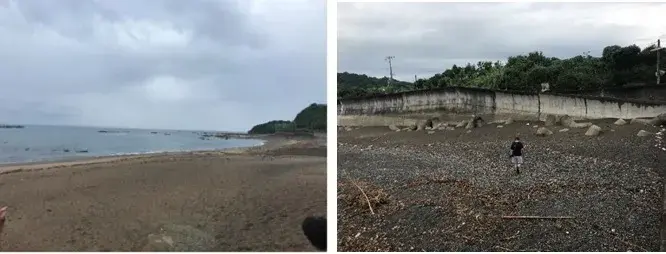
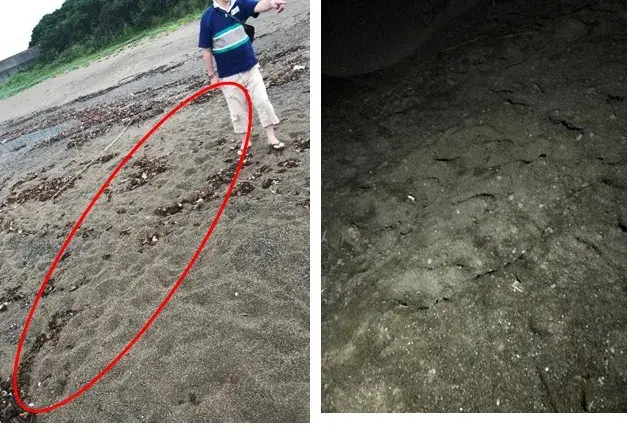
Many people imagine that researching wildlife involves waiting for hours, hiding in the shadows so you can't be seen. However, the Minabe loggerhead turtle survey was the exact opposite, requiring a 15-minute walk followed by a 15-minute rest, and repeated trips back and forth along the beach, making for a very physically demanding survey. It takes less than an hour for a loggerhead turtle to come ashore, lay its eggs, and then return to the sea. The beach is approximately 1.3 km long, so it's impossible to know where it will land. To avoid missing them, the researchers took the approach of walking constantly, taking breaks in between. (Note: Turtle footprints that weren't there on the way there were found on the way back - proof that the turtles were there!) This activity took place over two days, from 9 PM to 2 AM. It wasn't easy walking on the sandy beach, rocky areas, and parts of the river in unfamiliar diving shoes at an unfamiliar time, but the excitement of walking while thinking that there might be sea turtles, and the time to just sit and daydream while listening to the sound of the waves during breaks, were things that you rarely get to experience in the life of an office worker.
2. Minabe, the town of plum blossoms
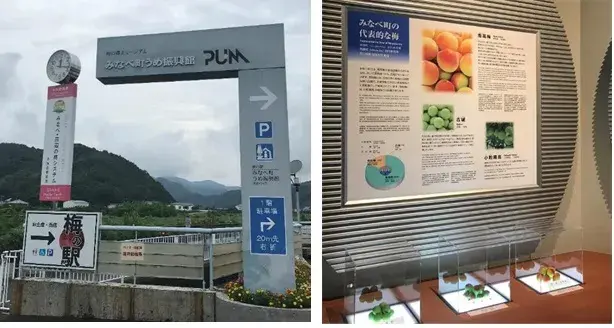
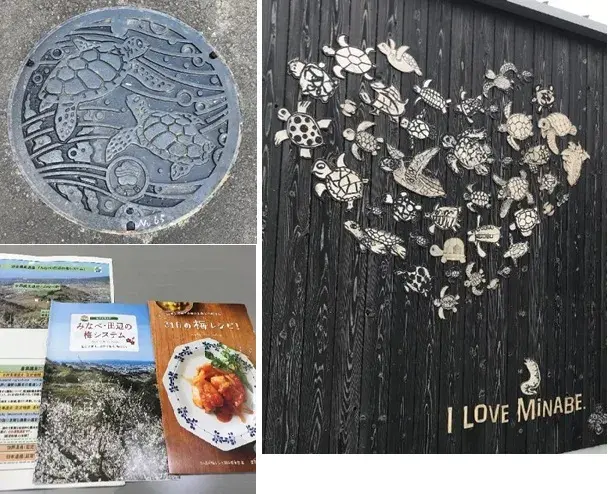
In the afternoon of the second day, we had time to learn about Minabe Town. We learned that plums account for 90% of the town's agricultural cultivation area, plum-related industries account for 70% of the town's primary, secondary, and tertiary industries, and that Minabe even has a "Plum Department" at its town hall. You may have heard of the term "Nantaka Ume," which refers to the plum variety "Nantaka." Apparently, it was named after the research conducted there by teachers and students from Minabe High School in 1965. Minabe is also one of only 11 designated "Globally Important Agricultural Heritage Systems" (a system that preserves biodiversity through plums). While we visited the area to survey sea turtles, we realized that plum culture is even more deeply rooted in the area than sea turtles. Some of the support staff were plum farmers, and seeing them contribute significantly to sea turtle conservation efforts despite their full-time jobs (they're not researchers or volunteers, but local people who work independently, driven by a desire to improve their town) gave us a glimpse of what conservation truly means.
3. Things you can only experience by staying overnight
Just as impressive as working with the Minabe Town support staff was the opportunity to learn about the latest research being conducted through conservation efforts. Dr. Matsuzawa, who accompanied the volunteers, is the president of the Sea Turtle Association of Japan and a leading expert on sea turtle research worldwide. Over two days, we received in-depth lectures from him (about his research to date and future plans, etc.), conducted fieldwork together, and after the survey, gathered in his room to chat until the early hours of the morning. This was a truly luxurious and rewarding experience, even more so than watching sea turtles lay their eggs. I don't think I would have been able to make this connection had I been a mere volunteer (it's rare to have an authority on the sea turtle world explain sea turtles from the very beginning to a complete layperson!). The synergistic effect of working together with people from different backgrounds—volunteers, local staff, and researchers—has broadened my perspective.
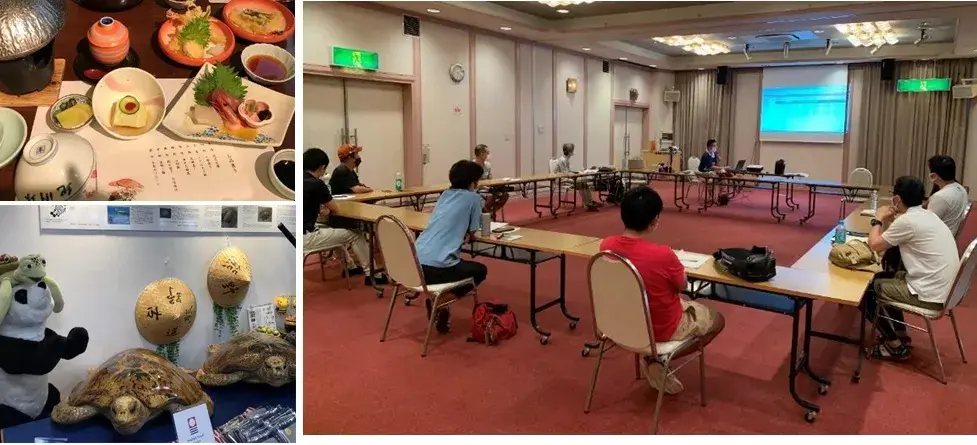
4. Create interest and expand the circle
If you ask me if participating in this volunteer work has enabled me to do anything, my answer is "No," and I haven't come to the conclusion that sea turtle conservation activities are directly linked to the preservation of the natural (ocean) environment. However, I have developed a more positive interest and curiosity. Sea turtles, which are an extraordinary sight for me, are an everyday sight for the locals, and for researchers, they are a benchmark for thinking about this world. When we hear terms like SDGs and environmental protection, we often feel intimidated, but the trigger or the first step can be something as simple as a "curiosity" that is close to us. Whether or not you have that can change how you think about even a single piece of trash in front of you. You don't need to rack your brain wondering what it has to do with your current job. Perhaps this volunteer program could be a good starting point, and you could just jump into the circle. Personally, I would like to visit Minabe Town again next year at the same time, this time to see sea turtles for sure.
As an aside, when I asked Professor Matsuzawa, "What are your recommended aquariums (in Japan)?", I received the following answer.
Please use this as a reference when you go out to play.
Oita Marine Palace Aquarium "Umitamago"
, Nagoya Port Aquarium
, Sunshine Coast Aquarium/Sumida Aquarium (if in the Kanto region)

- Financial News
- I participated in NYK Minabe's loggerhead turtle research program! (July 14-16, 2022)