
The first Kuroshima training experience
I was recently selected as a member of the first Kuroshima training program, and traveled to Kuroshima, a remote island about 30 minutes by ferry from Ishigaki Island,
to participate in practical training at the Kuroshima Research Institute, which studies sea turtles, as well as a port cleanup activity. I was filled with anticipation and hope to see with my own eyes
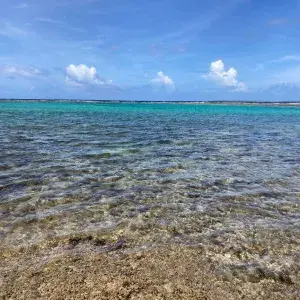
Kinkai Yusen, is being used to study the ecology of sea turtles, and just how beautiful the sea famous for its "Kuroshima Blue" really is
.
Cleaning activities
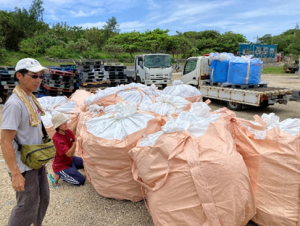
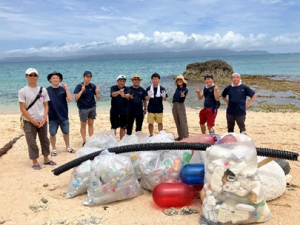
One of the objectives of this cleanup activity was to clean only Nishinohama beach. When you hear "Nishinohama," you might simply think of the sea on the west side, but that's not the case! In Okinawa, the directions for east, west, north, and south are not "tou, zai, nan, boku" but "agari, iri, hae, nishi." Therefore, Nishinohama = North Beach. Located facing north, Nishinohama offers views of Kohama Island in the distance and Iriomote Island to the left. The day we conducted the cleanup was a staggering 31 degrees Celsius, even though it was June. Working under the strong sun was a test of endurance against the intense heat. The beach was littered with a large amount of plastic bottles, styrofoam, and fishing buoys, polluting the beautiful white sand. Korean and Chinese were everywhere on the caps and labels, highlighting the abundance of washed-up debris. After about 30 minutes, the garbage bags were full, and we were able to collect about four flexible container bags full of garbage in about two hours. However, since Kuroshima does not have a garbage incineration facility, we were only able to collect plastic waste this time, and unfortunately, we were unable to collect glass bottles and other items.
so that mother turtles who have come all the way to Kuroshima to lay their eggs will see a clean ocean instead of one littered with trash
後も定期的な清掃活動を行わなければならないなと強く思いました。
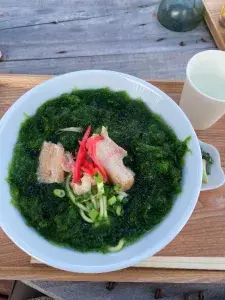
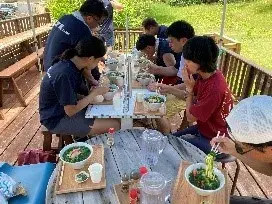
After the cleanup, it was finally time for lunch! We had asa soba at Heart Land, a restaurant right in front of the port. In Okinawa, asa means green seaweed. The soba noodles topped with plenty of beautiful green asa harvested on the island were absolutely delicious, and the delicious soup soaked into our dry throats, and we finished them in no time!
Activity time!
This time, with the support of the trainees, I was able to experience snorkeling! The training is important, but actually, I was really looking forward to this time... (laughs)
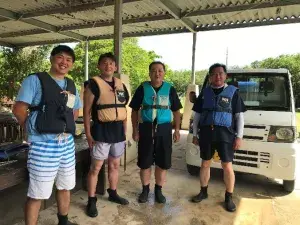
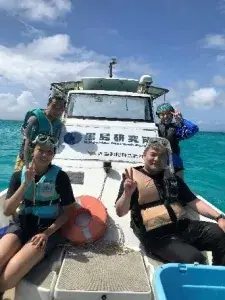
We boarded the donated boat AKARI and stopped the boat about 20 minutes offshore from the port. We received instructions on safety precautions and equipment for snorkeling, and were all set! Off to the underwater world!
It was... a world of beauty that is beyond words. There were lots of brightly colored fish, green and red, swimming freely around the coral reefs. I also relaxed my body and tried not to think about anything difficult, just imprinting the world in front of me into my memory. I was grateful to be able to enjoy this moment. At first, I was worried about what would happen if I couldn't breathe properly, but once I got in the water, it was no problem at all! Rather, I wanted to look at the sparkling blue world for as long as possible, so I stayed immersed in the underwater world until the researcher gave the signal to ascend.
When we returned to the port, the sea I saw from the boat was crystal clear, and it was a completely different color from the sea I knew. I realized there are still so many things I don't know, and I strongly feel that I want to learn more and cherish the experience of discovering things I didn't know before.
What I felt during the three days
Visiting the Kuroshima Research Institute, a place frequented by people of all ages from young children to the elderly, allowed me to experience firsthand the ecology of sea turtles and the environment of the Yaeyama Islands. Listening to researchers, and even touching the animals themselves, was an invaluable experience for me.
If AKARI hadn't been donated to the Kuroshima Research Institute, I don't think I would have learned about Kuroshima or the ecology of sea turtles.
Boats are an essential part of life on Kuroshima. While in everyday life, garbage is collected and transported to processing facilities, here on Kuroshima, garbage must be transported off the island by boat, incurring additional costs and time. Kuroshima, lacking rivers, has a water supply monument. In the past, during droughts, people had to rely on stored rainwater or travel to Iriomote Island by boat to fetch water. I was deeply reminded of the importance of boats, which transport people and goods, and are sometimes used for environmental protection activities and research.
The first thing I can do for environmental protection is to take my garbage home. When spending time in nature, I will try not to burden the natural ecosystem. I had always assumed that sea turtles were endangered solely because of the marine plastic pollution problem, but I learned that human activities have also contributed to this, such as the lack of suitable nesting grounds. I wouldn't have realized these various issues without this training. I truly
felt that seeing and experiencing things firsthand over these three days allowed for a deeper understanding. Thank you so much for giving me this invaluable opportunity.

- Financial News
- The first Kuroshima training experience