
The first Kuroshima training experience
I was selected as a member of the first Kuroshima training group, and traveled to the remote island of Kuroshima, about 30 minutes by ferry from Ishigaki Island,
to participate in practical training at the Kuroshima Research Institute, where sea turtle research is conducted, as well as in port cleanup activities. I was filled with anticipation and hope to see
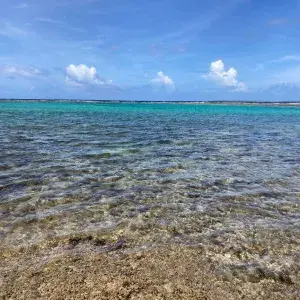
Kinkai Yusen , is being used to study the ecology of sea turtles, and how beautiful the famous Kuroshima blue sea is
.
Cleaning activities
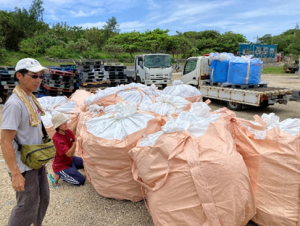
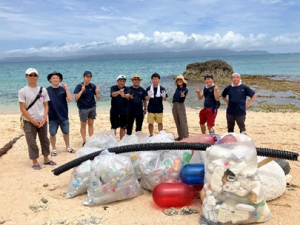
One of the goals of this cleanup was to clean only Nishihama Beach. Simply hearing "Nishihama Beach" might make you think of the ocean to the west, but that's not true! The east, west, north, and south of Okinawa are not called "Tou, Zai, Nan, Boku" but "Agari, Iri, Hae, Nishi." Therefore, Nishihama Beach = Kitahama Beach. Nishihama Beach faces north, with Kohama Island in the distance and Iriomote Island to the left. Even though it was June, the temperature on the day of the cleanup was a staggering 31°C. Working under the intense sun was a test of physical endurance. The beach was littered with plastic bottles, styrofoam, and fishing buoys, all of which littered the beautiful white sand. Korean and Chinese writing was everywhere on the caps and labels, and drifting trash was noticeable. Our garbage bags were full within 30 minutes, and we collected about four flexible container bags in about two hours. However, because Kuroshima does not have a waste incineration facility, we were only able to collect plastic waste this time; unfortunately, we were unable to collect any glass bottles or other debris.
continue
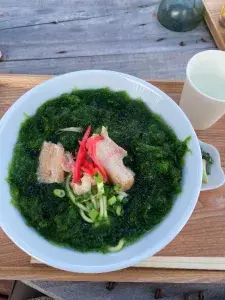
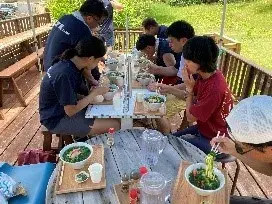
After the cleanup, it was finally time for lunch! We had asa soba at Heart Land, a restaurant right in front of the port. In Okinawa, asa means green seaweed. The soba noodles topped with plenty of beautiful green asa harvested on the island were absolutely delicious, and the delicious soup soaked into our dry throats, and we finished them in no time!
Activity time!
With the support of the trainees, I was able to experience snorkeling! While the training was important, I was actually really looking forward to this experience! (laughs)
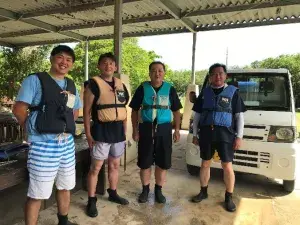
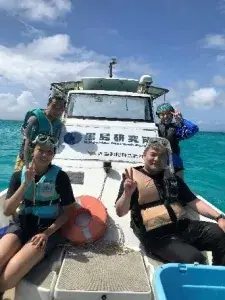
We boarded the donated boat, the Akari, and docked about 20 minutes offshore. After receiving instructions on snorkeling precautions and equipment, we were fully prepared! Off we went!
It was a world of indescribable beauty. Around the coral reef, vibrant green and red fish thrived, swimming freely. I also relaxed and focused on the world before me, without thinking too hard about anything. I was grateful to be able to enjoy this moment. At first, I was worried about not being able to breathe properly, but once I got in the water, it was completely fine! I wanted to linger and gaze upon the sparkling blue world for as long as possible, so I immersed myself in the underwater world until the researcher told me to come back up.
As we returned to the port, the ocean was crystal clear from the boat, completely different from the ocean I knew. I strongly felt that there is still a lot I don't know, that I want to know more, and that I want to continue to cherish the experience of learning things I didn't know.
What I felt during the three days
Visiting the Kuroshima Research Station, visited by people of all ages, from small children to the elderly, I was able to experience and learn firsthand about the ecology of sea turtles and the environment of the Yaeyama Islands. Listening to researchers and even touching and experiencing the creatures firsthand was a truly invaluable experience for me.
Without the AKARI donation to the Kuroshima Research Station, I doubt I would have learned about Kuroshima or the ecology of sea turtles.
Boats are an essential piece of infrastructure for life on Kuroshima. While trash is routinely collected and transported to a treatment facility, on Kuroshima, it must be transported off the island by boat, which requires additional time and money. Kuroshima, which has no rivers, has a waterworks monument. In the past, during droughts, people had to rely on collected rainwater or travel by boat to Iriomote Island to fetch water. I was reminded of the greatness of boats, which transport people and goods and are sometimes used for environmental conservation activities and research. The
first thing I can do to protect the environment is to take my trash home with me. When spending time in nature, I try not to burden the natural ecosystem. I had always thought that sea turtles were an endangered species because of the problem of marine plastic, but I also learned that there are other reasons, such as a lack of suitable nesting sites due to human activities. I would not have been aware of these various problems if I had not taken this training.
By actually seeing and experiencing these things with my own eyes and bodies over these three days, I realized that I could gain a deeper understanding. Thank you very much for this valuable opportunity.

- Financial News
- The first Kuroshima training experience