
Participating in the NYK Kishu Minabe Loggerhead Turtle Survey (The Sea Turtle's Tears Speak)
I had the opportunity to participate in a volunteer survey in Minabe Town, Wakayama Prefecture, for three days from Sunday, July 21, 2024. The
survey was supported by NYK Line and organized by the NPO Earthwatch Japan with the cooperation of the Sea Turtle Council of Japan (Chairman: Yoshimasa Matsuzawa). I would like to report on the survey.

Volunteering is hard
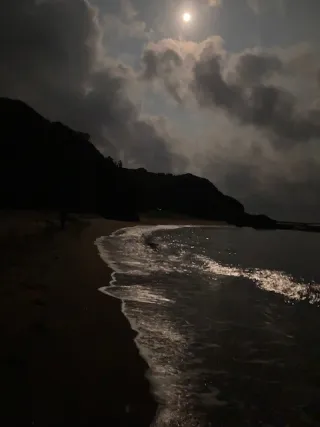
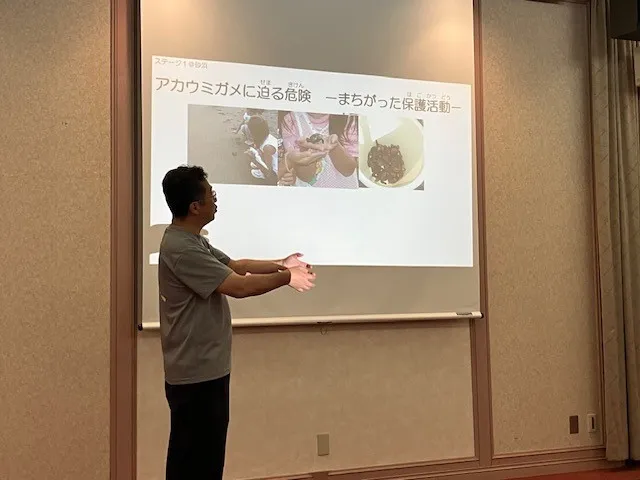
After a lecture from Professor Matsuzawa on sea turtles and sea turtle conservation efforts in Minabe Town, we set off to assist in the survey that night. We split into two beach teams and headed out to sea to search for sea turtles that had landed. Our Chirihama team patrolled the approximately 1km stretch of Chirihama beach in hourly shifts from 8:00 PM to 2:00 AM. We walked along the beautiful beach under the full moon, searching for turtle footprints. On a sauna-like hot night, our feet got stuck in the soft sand. There was no time to enjoy the beautiful ocean; it was simply exhausting. On the first day, a team from another beach, Iwashirohama, successfully attached a transmitter to one turtle. Our Chirihama team found signs of a turtle landing. However, although it had landed, it apparently returned without laying eggs. It is speculated that it was frightened by train and car lights. It's a delicate species. On the second day, we were able to attach a transmitter to a new turtle at Iwashirohama. It is said that this individual may have returned from Chirihama on the first day without giving birth.
Being a mother loggerhead turtle is tough
Here, I'd like to introduce the loggerhead turtle, which I learned about from my professor.
The loggerhead turtle (Caretta caretta)
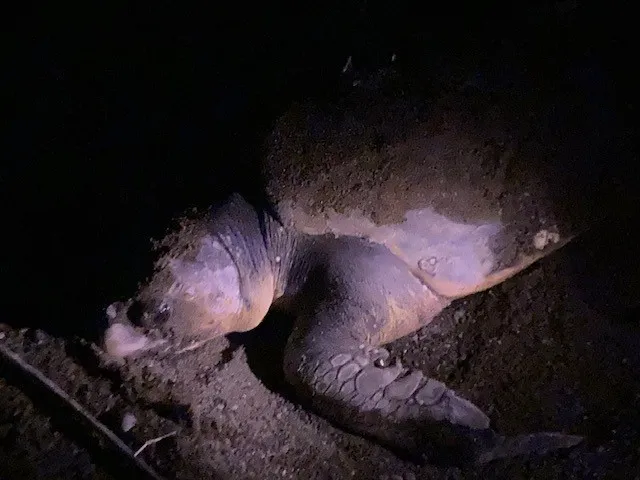
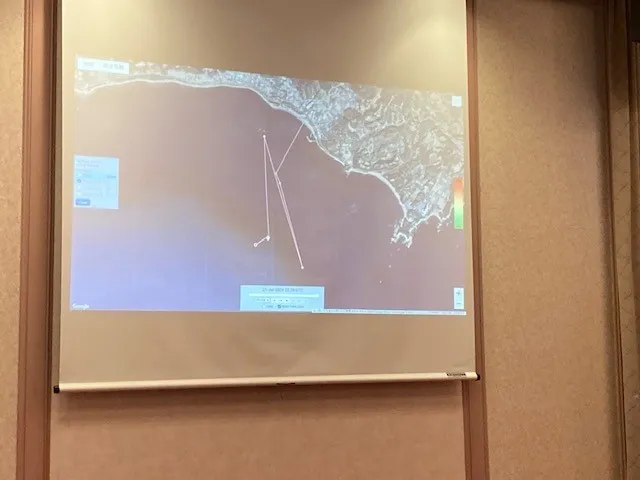
is an endangered species, with a particularly sharp decline in population in recent years. It's an omnivorous carnivore, primarily feeding on bottom-dwelling creatures (shellfish and crustaceans; green turtles are herbivores, such as seaweed and seagrass). It has no gills, breathes through lungs for two hours, and can dive to depths of about 200 meters. Its lifespan is estimated at 70 to 80 years. In the East China Sea, food supplies have decreased due to the increase in bottom trawl fishing, forcing many individuals to wander the ocean where food is scarce. Their natural predators are killer whales and sharks. Their nesting grounds are Japan and Jeju Island in the North Pacific, but no landfall on Jeju Island has been confirmed since 2007. In Florida, marine plastic waste has been found in 93% of sea turtles. However, most of it is excreted undigested. It is believed that they possess a powerful geomagnetic compass, which allows them to navigate with considerable accuracy by tracking the position of the sun. A sea turtle's sex is determined by the temperature at which the eggs are laid. Males hatch when the sand temperature is below 29°C, and females hatch when it's above 30°C. As global warming progresses, females will emerge first, and eggs will die at temperatures of 33°C. Females can only ovulate once they have prepared their eggs and mated. I was shown a GPS track map of an individual believed to be wandering around Osaka Bay, unable to find a male. It seems the decline in males may already be underway. Recently, with increasingly severe ocean conditions, eggs are often washed away by high tides and waves. The vegetation on the beach serves as a marker to indicate that high waves are not approaching. The mother turtle desperately tries to climb the sand dunes to this point. Her intense breathing lingered in my ears.
On average, sea turtles reach sexual maturity, become adults, and are able to reproduce at around 40 years of age. The effects of current global warming will also become apparent in 40 years. I was surprised at how delicate this ecology is.
In addition to these challenges, modern life is full of trials and hardships, such as man-made structures (such as fishing port developments) taking away sandy beaches, light pollution (hatched turtles perceive the direction of light as the ocean, mistaking the lights of trains, cars, and towns for the ocean and heading in the opposite direction, resulting in their deaths; mother turtles dislike light and are unable to land), and even drowning after getting entangled in fishing nets.
Sea turtles also play an important role in transporting nutrients from the ocean to land. Even if only about half of the eggs actually hatch, roughly two-thirds of the total, including waste products used in the eggs and unhatched eggs, will provide nutrients for terrestrial organisms. Sandy beaches are nutrient-poor environments. Turtles support this vegetation with nutrients, and plants play a major role in maintaining the beaches. The story goes that beach stability is crucial for both beach maintenance and ecosystem health. Maintaining ecosystems is a harsh reality. For these reasons, even here in Minabe Town, the number of sea turtles landing and laying eggs has plummeted.
The bees are suffering too
Meanwhile, Minabe Town's "Minabe-Tanabe Plum System" has been registered as a Globally Important Agricultural Heritage System. Satoyama forests produce Kishu Binchotan charcoal, plum groves cultivate high-quality plums, and the town has abundant rice paddies, protecting the vegetation and environment behind the coast. Healthy agriculture and forestry are the town's core industries, and the town is being built without using sea turtles as a tourist attraction. The town office is understanding and supportive of sea turtle research, and the youth group is also active in providing support. It is a kind and wonderful town.
However, this year's plum harvest was the worst in recent years. The extremely warm winter apparently deactivated the honeybees responsible for pollination, and pollination did not progress at all. This raises concerns about the effects of global warming.
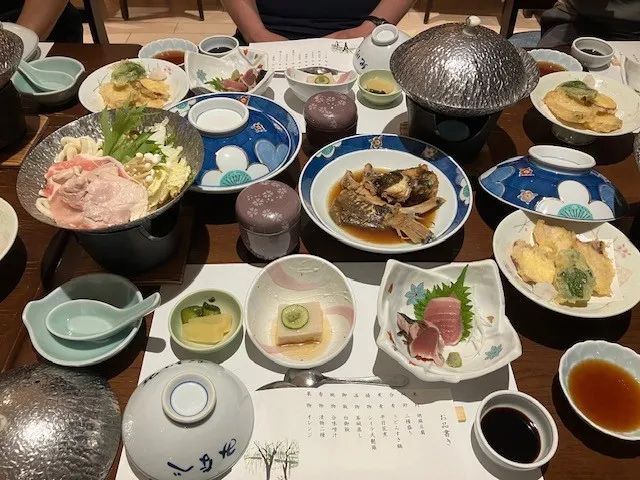
It's so hard to face such a delicious meal!
By the way, the food on this program is very, very delicious. However, with all this delicious food, there was no beer, so we ate our meals in about 30 minutes and headed off to work late into the night. We also had all-you-can-eat umeboshi, a specialty of Minabe!
Learning
The sea turtle research has no direct impact on our business or the economy. However, I know this may seem presumptuous, but I believe that what we have learned through basic biological research speaks to the reality of global environmental issues. There is still so much we do not know about the world around us. Through this sea turtle research, I was reminded once again of the many important realizations and lessons we have to learn. I feel that this type of research and research support is extremely important. I learned that ecosystems are delicate, and even a temperature change of 1 or 2 degrees can have a huge impact. Meanwhile, I learned that each transmitter attached to a sea turtle costs $4,000. I also learned that the labor and research costs for researchers and volunteers are significant. I sincerely hope that this Minabe loggerhead turtle research will continue, that research results will be produced and shared with the world, and that the NYK Group's support will continue. I hope that employees will participate again next year.
At the final seminar, we all gave names to the loggerhead turtles. Data from the transmitters will be tracked and stored under these names. The turtle that was born on the first day was named "Luna-chan" after the full moon night, and the turtle that had a transmitter attached on the second day was named "Tae-chan." There were shark bite marks on "Tae-chan's" shell, so the turtle was named after her for enduring the difficult journey and coming to lay eggs, as well as for enduring the process of having a transmitter attached after laying eggs.
Good luck, Luna-chan, Tae-chan and everyone at Minabe!
Return to list
- Financial News
- Participating in the NYK Kishu Minabe Loggerhead Turtle Survey (The Sea Turtle's Tears Speak)