
What kind of island is Kuroshima?
As announced on our company website under "Kuroshima Research Institute Report" ( Kuroshima Research Institute Report – Kinkai YusenCo., Ltd. ) , we conducted our first Kuroshima training session in June 2025. All participating employees were asked to submit a training report after the session. Among the many excellent reports, we would like to share one of them with you today.
Introduction What kind of island is Kuroshima?
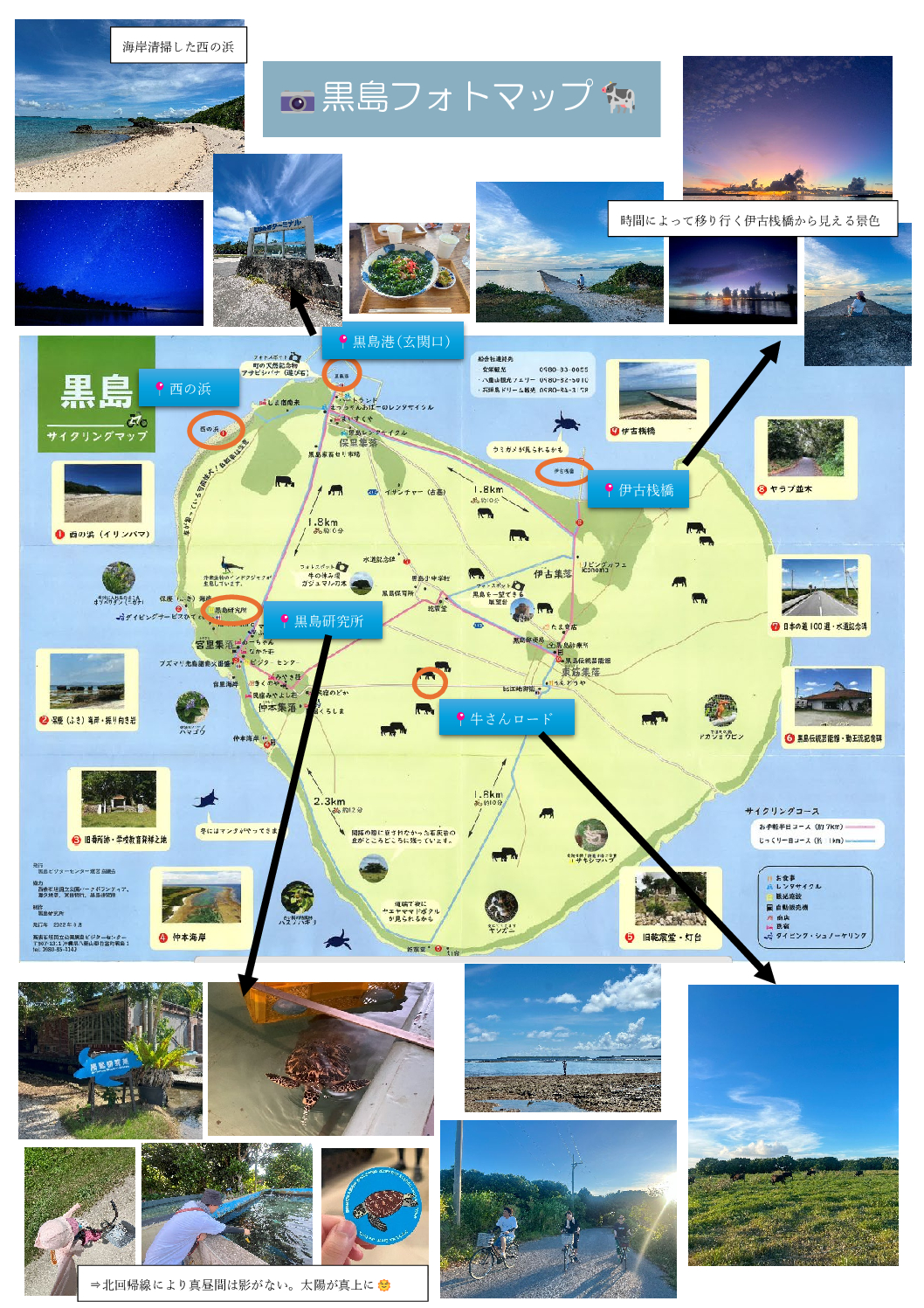
Kuroshima is an island in the Yaeyama Islands of Okinawa Prefecture. The Yaeyama Islands are a collective name for the islands located about 400 km southwest of the main island of Okinawa, and are made up of 32 islands of various sizes, centered around Ishigaki Island. Kuroshima is one of the islands in the Yaeyama Islands, and is famous as "an island with more cows than people," and is also known as "Heart Island" because of its heart-shaped shape. The island is rich in nature, with black cows grazing freely everywhere. Tourists get around by rental motorbike or bicycle. It is a small and quiet island.
Kuroshima Research Institute
Founded in 1975, Kuroshima Research Institute is one of Okinawa's oldest marine biology research institutes. It is a small aquarium and museum, exhibiting a variety of creatures including fish, coconut crabs, vipers, sea turtles, peacocks, chickens, and sharks. It is also an interesting research institute with a wide range of exhibits, including specimens of Kuroshima's animals, coral, and debris from space. Although it is primarily a facility for researching sea turtles, it is open to the public and has become a tourist spot on Kuroshima.
Coastal cleanup
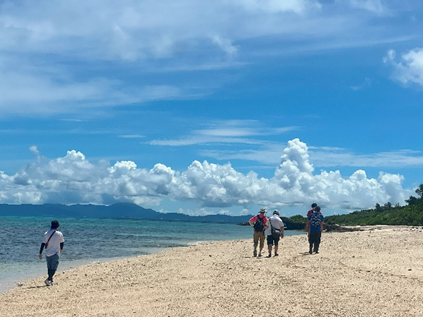
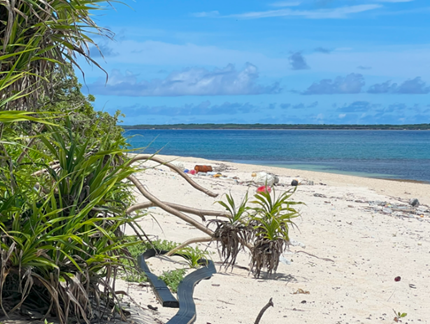
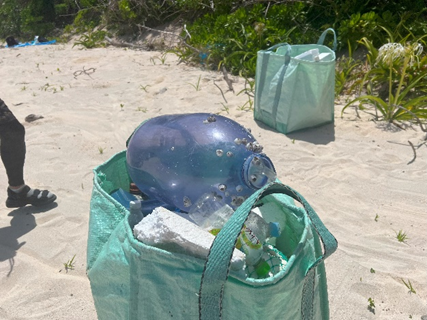
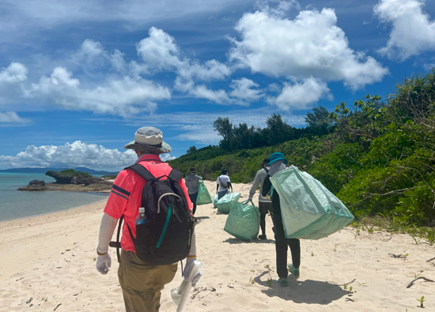
We spent an hour cleaning up Nishinohama Beach. The beach looks clean in the photos, but there was a lot of trash lying around, with a variety of trash washed up, including plastic bottles, glass bottles, cans, styrofoam, and floats. Some of the bottle labels were written in Chinese and Korean, and many of them appeared to have washed up from overseas. Although we worked in the heat, we were able to experience firsthand the importance of beach cleaning in creating an environment where sea turtles can lay their eggs on the beach. We have also cleaned beaches in Tomakomai, but there was far more trash at Nishinohama Beach. 10 people, including staff, worked together and collected enough trash to fill the back of a light truck and make three trips there.
Night walk to find sea turtles laying eggs
After dinner, we headed out to the west beach at 8pm to witness sea turtles laying their eggs.
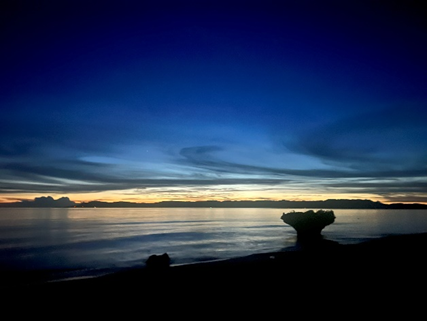
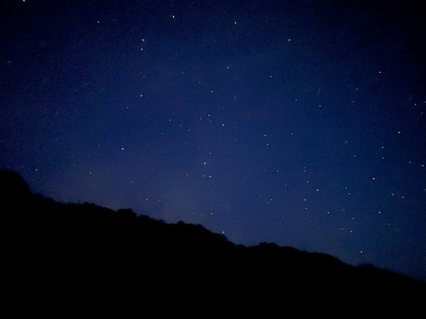
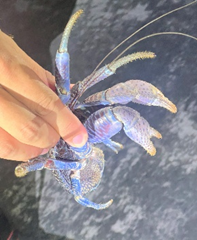
We turned off our flashlights for about an hour and strolled along the coast using only red lights that are gentle on sea turtles. Unfortunately, we didn't witness any egg-laying...
however, we were able to observe coconut crabs and other marine creatures that we wouldn't normally see during the day, making for a very fulfilling experience. All the creatures we encountered on Kuroshima were large in size, giving us a real sense of being in the heart of nature.
Sea turtle release
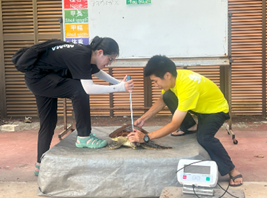
On our last day on Kuroshima, we witnessed the release of green sea turtles for research purposes at the research institute. Sea turtles are endangered, so it is essential to constantly keep track of and observe the number of individuals and their whereabouts. The research institute also conducts tagging surveys. Sea turtles that come ashore to lay eggs or that are caught in fishing activities are tagged. This makes it possible to study the movements and growth of tagged sea turtles the next time they are found. To date, the Kuroshima research institute has used 5,000 tags.
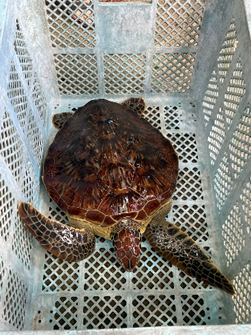
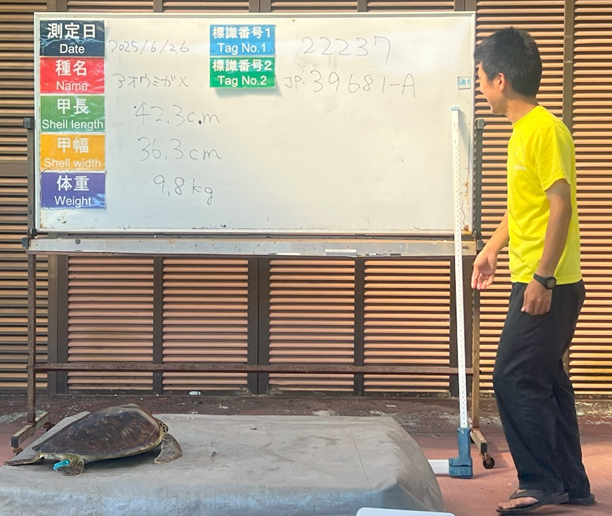
Species: Green sea turtle Carapace
length: 42.3 cm
Carapace width: 36.3 cm
Weight: 9.8 kg
Tag number 1: 22237
Tag number 2: JP39681-A
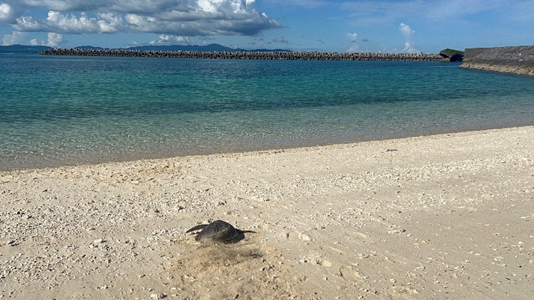
This is how we measure the sea turtles we are releasing. It was my first time holding a sea turtle, and it was so cute, flapping its wings. It was a truly valuable experience. The release took place on a beach near the Kuroshima Ferry Terminal. The turtle turned its back to the sea, and even after being released, it changed direction on its own and returned straight to the sea. Even after the release, we were able to see the green turtle swimming comfortably from the beach, which was a heartwarming experience.
Kuroshima Optional Training
Ranch experience
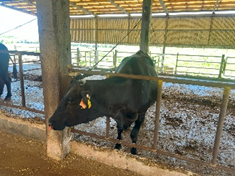
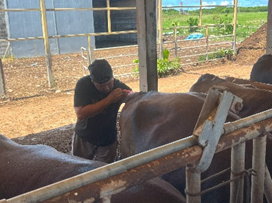
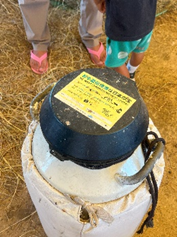
On Kuroshima, where the number of cows outnumbers the number of people, more than 3,000 cows are raised. We had the opportunity to experience feeding the cows and observe artificial insemination in the cowshed. Artificial insemination of cows is done entirely by hand. The uterus of a female cow in heat is touched, checked for engorgement, and sperm is injected. Sperm collected from a high-quality brand cow is said to fetch up to 10,000 yen. A cattle auction is held every two months, and dairy farmers from all over the country visit to raise the cows in their respective regions, which then become Yamagata Beef, Kobe Beef, and Matsusaka Beef. As many as 150 cows are auctioned at one time. All the cows live freely and are raised with love from their owners.
Boarding the oceanographic research vessel AKARI
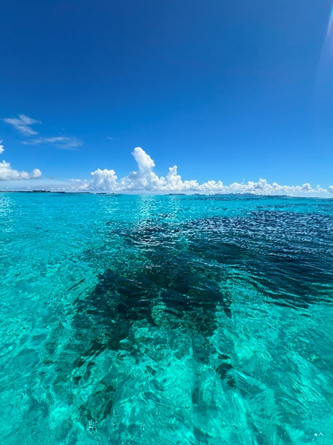
I went on a snorkeling tour aboard the AKARI. The waters around Kuroshima are very clear, and although I've been to the ocean in Okinawa several times, it was the first time I'd seen such clear water. I was also able to observe the fish that live on Kuroshima, and I'll never forget the view of Kuroshima while cruising on the donated AKARI boat.
The fish on display at the Kuroshima Research Institute are often caught by people aboard the AKARI or by diving off the west coast, and we are pleased that they are useful for research and investigation.
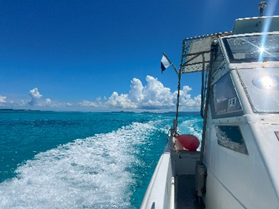
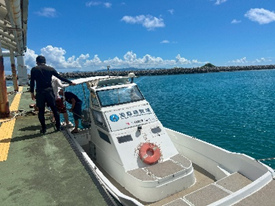
Visit to the Tsushima-Maru Memorial Museum
On the final day of the training, we visited the Tsushima Maru Memorial Museum and had the opportunity to speak with Mr. Teruya (85 years old), who was on board the Tsushima Maru, was involved in an accident, was rescued, and now gives lectures as a storyteller.
The Tsushima Maru was a cargo ship belonging to its parent company, Nippon Yusen Kaisha (NYK Line), and during the Pacific War, it was used to transport evacuees from Naha to Nagasaki. The Tsushima Maru sank at 10:21 PM on August 22, 1944, 11 minutes after being hit by a torpedo from the American USS Bowfin.
Teruya, who was rescued, was four years old at the time. She was on the ship with her mother and older sister when it was attacked, and she jumped into the sea to get away from the ship. Afterwards, Teruya's mother went to look for her sister, and Teruya clung to a soy sauce bottle cap and was rescued 16 hours later. That was the last time she saw her mother, and she never saw her again. Teruya vividly described her emotions and what she saw at that time, even though she was a child.
During the war, a gag order was issued not to talk about this accident, and despite more than half of the evacuees dying, the survivors were not even able to mourn their grief.
The Tsushima Maru Memorial Museum displays photographs of the events at the time and of those who died. Hearing the voices of the families and those who were rescued reinforced my belief that war should never happen.
Conclusion
This time, participating in the Kuroshima training program allowed me to learn about aspects of Kuroshima that I couldn't learn as a tourist, such as the ecology of sea turtles, which I had only ever seen in aquariums before, and the creatures that live on the island. I learned a lot about the charm of Kuroshima, which is loved by sea turtles and cows. The island residents were also very warm, and I am very grateful to the Kuroshima Research Institute for providing this opportunity.
The climate, clouds, and sea views are completely different from Hokkaido, where I live, and everything was fresh and very stimulating, making Kuroshima an island I love. As part of environmental protection, I strongly want to continue contributing to activities that protect sea turtles. Through this training program, my perspective and values regarding Okinawa and Kuroshima have changed significantly, making it an extremely valuable opportunity.

- Financial News
- What kind of island is Kuroshima?